
My recent posts about HiFi equipment repair have been among the things that have initiated folks asking what the difference between record players and turntables. Let’s look at what makes them different from each other.
Setting the Scene
Not too many years ago “everyone” knew the differences between record players and turntables. Record players came first while turntables as we know them are really a product of the HiFi rise of the 1950s. Over the last decade or three, as portable music players became popular and the recent trends toward streaming, conversations about older equipment have become rare. Not just conversations, by the way, but the use of machines, too.
The result is that people have lost the meanings of the terminology, how to use the equipment, and even the LPs, CDs, and tapes which need the equipment to be played.
What are Record Players?
Record players are machines that play records. Ok, too obvious, right? Let’s examine that. A record player includes the components for the tracks on the record to be heard. That means the record player has an amplifier, speakers, and the controls to adjust the sound.
The early Edison phonographs played wax cylinders instead of flat disks and had “mechanical-acoustic” horns instead of electric-electronic speakers. In what we could call “classic” record players the speakers are built in and not separate units. One of the most famous models of this design is the GE Wildcat record player. Look them up, they are still extremely popular.

Starting sometime in the 1960s the record player began to evolve into an all-in-one multi-purpose unit. At first these machines featured AM/FM radios. Later models included 8-track tape players. 8-tracks were replaced by cassette tape players. Some of these record players mimicked component HiFi systems by separating the speakers into separate elements.
Modern record players range from very simple suitcase models that are easy to carry around to complicated 6-way, machines that include record players, AM/FM, cassette tape, Bluetooth, and USB.
What are Turntables?
Turntables are a much simpler concept than record players. With rare exceptions, turntables can only “play” the record’s signals into a HiFi system and do not have amplifiers or speakers. An example of a rare exception is a Victrola model that I have in my collection. It looks like a regular turntable, but it has an amplifier built in a separate speakers. Technically, by definition, it is a record player, not a turntable. Weird, eh?
OK, so here’s how all this works. Originally, back in the day, when dinosaurs roamed the earth, the turntable was connected by cables to a pre-amp. The analog signal put out by a turntable is very weak compared to those put out by other HiFi components such as receivers, tape decks, and so on. The pre-amp was necessary to boost the turntable’s signal.
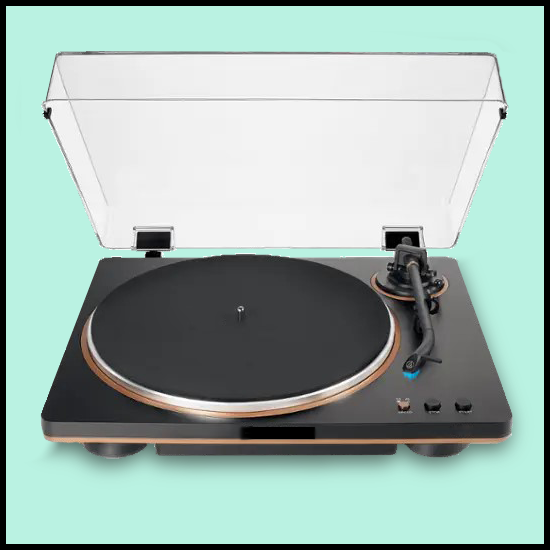
The pre-amp was then, in turn, connected to an amplifier. External speakers were, and are, connected to that amplifier. Other components are also connected thus creating a HiFi system.
As HiFi systems evolved the pre-amps were built into the power amplifier creating what is called an “integrated amplifier”. Later, radios were added, and the integrated amplifier became the “receiver”. Audiophiles interested in the ultimate of ultimate HiFi systems almost always prefer building a system using discrete components that include pre-amps, power amps, receivers, and so on. Separate components allow the assembly of highly customized audio systems.
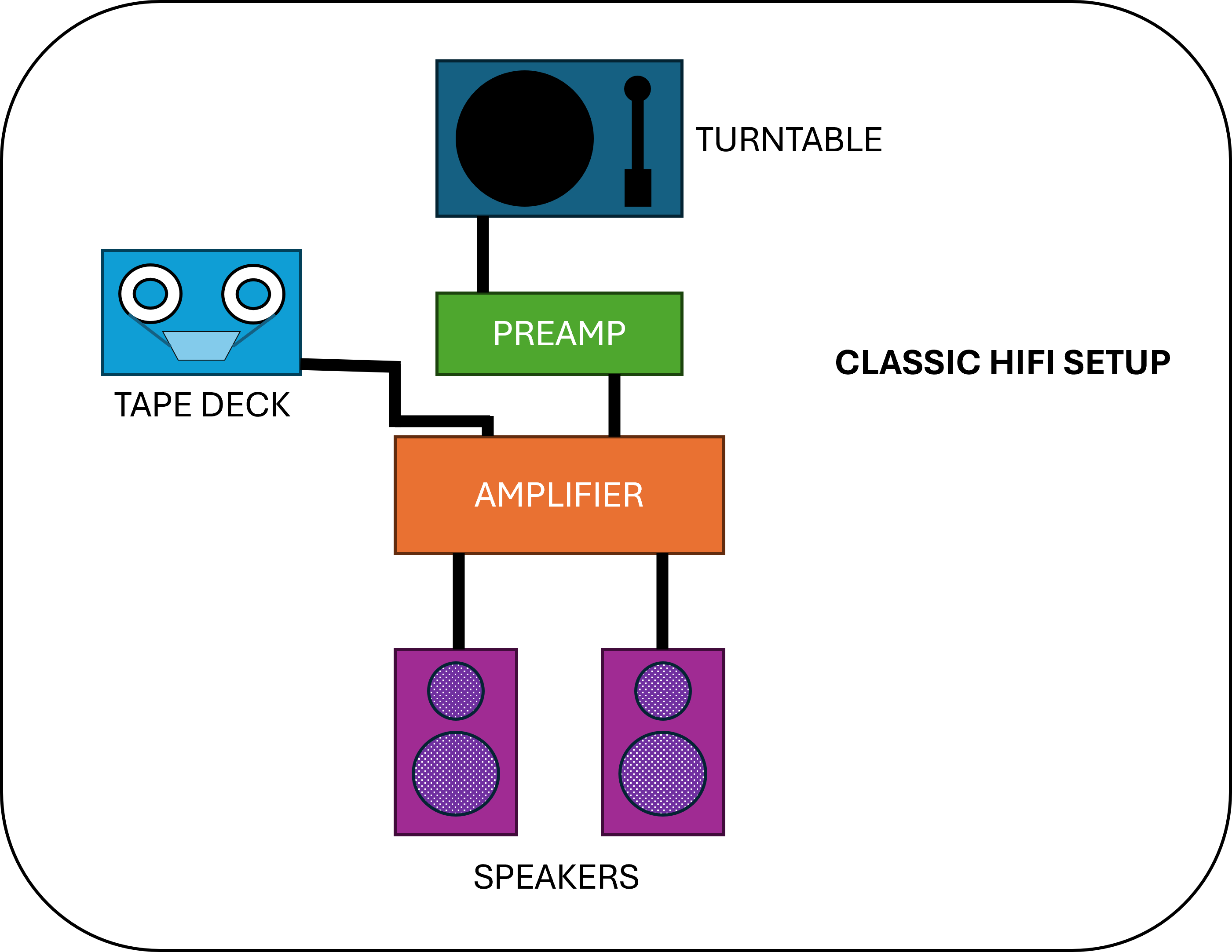
Modern turntables have new adaptations to meet current needs. Because a couple of decades ago the audio industry declared the 33 1/3 rpm LP to be dead and gone, the makers of amplifiers removed pre-amps from their receivers. Unfortunately, the declaration of death was not only premature, but highly wrong. The LP is alive and well, but amps made during that period are problematic because it is difficult to connect turntables to them.
As a solution some turntable manufacturers added a pre-amp to their products. Users can switch a turntable’s output from “phono” (standard record player signal output) to “line” (the higher signal strength output). This allows the turntable to be used with just about any amplifier or receiver.
Record Players vs. Turntables – Which Is Better?
Oh, boy, this question will cause all-cap shouting in the online forums. Frankly, bluntly, and to the point, the answer is ——- it all depends.
Looking as the question from a technical perspective, it is important to remember that a record is a fragile object. The more you play it, the more it deteriorates. This cannot be avoided. The problem is universal. The first time you play a record, 45 rpm or 33 1/3 rpm LP, a degree of damage has been done. On top of that, if your machine has the ability to play a 78 rpm record you not only degrade the record, but the machine itself is slightly worn as those sorts of records are highly abrasive to the stylus.
The rule of thumb is that a properly setup turntable will cause less wear to a record than will a record player. The reason for this is that record players use rather inexpensive and “basic” parts. There may be an exception to this rule, but I cannot think of one. These price-conscious parts cause more wear on the records.
On the other hand, turntables have only one job, and that is to extract the signal from a record and send it to an amplifier, and this means the manufacturers can emphasize the engineering and design to minimize record wear. Prices for a turntable, at the time of this writing, range from adequate turntables starting around $99 to pretty good ones at $200 to fantastic turntables exceeding $10,000 in cost. I recently saw a review of a turntable that cost more than a new KIA. Exotic materials and engineering is the norm. Wild features such as stone plinths, pendulum stabilization, and exotic metal and carbon fiber arms are not unusual, just expensive.
With all that in mind, the question still stands, which is better?
For record collectors, audiophiles, tech fans, and so on the turntable is the far better choice. Anybody with rare records almost certainly should be using a turntable and associated HiFi system.